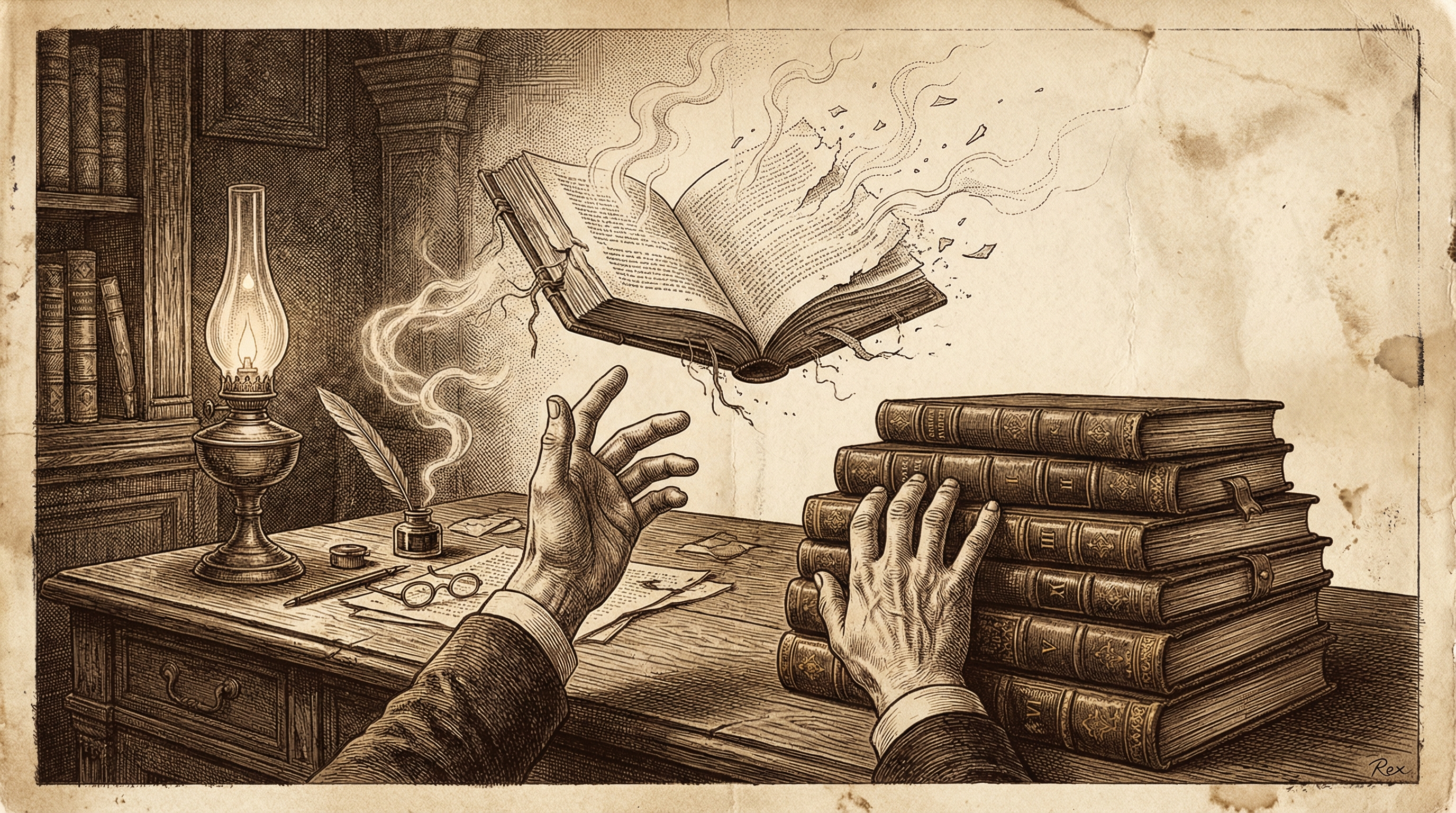
I’ve been an avid reader all my life. I even have a degree in English Literature & Culture.
I’ve read hundreds of books. Fiction, non-fiction, fantasy. Some of the best journeys of my life have been following Uthred through the Last Kingdom Series, or Cicero’s slave through Robert Harris’s Dictator series. Or Pierre in War and Peace.
For years I’ve been wanting to get into science fiction. Some of dearest friends are big fans. Some of the most successful people in the world like Elon Musk, Naval Ravikant, Bill Gates and Jeff Bezos are science fiction readers. Obviously there is something about science fiction that these big thinkers are attracted to. And when you look at the most mentioned books on Hacker News, it’s very clear that my tribe loves to read science fiction.
I’ve had multiple attempts in the past. I’ve bought multiple copies of The Hitchhiker’s Guide to the Galaxy. I also tried Revelation Space by Reynolds. For some reason it never captivated me. It’s peculiar – I normally have a very annoying completionist attitude towards books. Just recently I white-knuckled my way through the last quarter of The Brothers Karamazov by Dostoyevsky. The story didn’t captivate me and felt too drawn-out. But I persevered and finished it.
Yet for some reason it doesn’t work when I try the same approach with science fiction.
When I made my first attempts years ago I wasn’t working as an engineer yet. I was working as a nurse in the hospital. I have since changed my career and have been working as a DevOps engineer for almost 5 years now. I spend my days writing code and building infrastructure for distributed systems. Since last year I’m teaching people to become DevOps engineers full-time. I figured that now that I’m a real engineer now, maybe I’ll resonate with the sci-fi more.
There are a couple of reasons why I feel attracted to science fiction. Firstly, it is an entire genre that I haven’t explored yet. There are complete universes that I could get into. Dune alone weeks or month’s worth of world building and exploration in stock for me. Secondly, I genuinely think science fiction can help me become a better engineer. I’m especially interested in science fiction that examines the relationship between machine and human or Artificial Intelligence. It might help me understand and navigate the world we live in now.
So I tried again. I started with Neil Asher’s Gridlinked. It seems perfect: someone who is hooked up to the equivalent to a more intelligent version of ChatGPT. I quit reading about 20% of the way in. Next I tried Hyperion. I read about 3/4 of it. The stories were interesting, and I genuinely enjoyed most of them. But towards the end, I find myself sighing “Shrike, shrike, yeah, yeah. Tell me something new.”
Maybe the stuff I’m reading is too advanced. Maybe I should start with something lighter. So I made my fourth attempt at reading The Hitchhiker’s Guide. The first one is a blast. Lots of bizarre humor and I really enjoyed it. But after finishing The Restaurant at the End of the Universe it feels like the same weird situation repeated time after time, and I don’t feel like I’m getting much out of it any more. It’s not stimulating deep thoughts about the relationship between machine and human.
In the spirit of science fiction, I decided to strike up a conversation with my favorite Large Language Model at the moment: Claude Opus 4.6. I’ve been using Claude for 2 years now, so it has memory of our past conversations. I talked at length about what I was struggling with when reading these books, and gave more context about what I do like to read.
The results surprised me.
I will let Claude give his analysis:
When I looked at the full picture — every book Mischa finishes and loves versus every book he bounces off — the pattern was immediately clear. The dividing line isn’t fiction versus nonfiction, or light versus heavy, or useful versus entertaining. It’s real versus invented. Every book he devours is set in the real world or built on real historical foundations. Cornwell’s Uhtred is fictional, but Saxon England is real. Harris invented dialogue for Cicero, but the Roman Republic actually collapsed. Shackleton’s expedition, Caesar’s Gallic Wars, Pillars of the Earth, Butcher’s Crossing, The Road — always a person navigating a harsh, physical, tangible world through skill and will. Science fiction, by definition, asks you to invest in worlds that never existed. And something in Mischa’s brain refuses that transaction. Every time. Reliably. Across fifteen years of attempts.
The ideas he wanted from science fiction — systems thinking, leadership under pressure, the relationship between technology and humanity — he’s been absorbing all along. The fall of the Roman Republic is a masterclass in how institutions collapse under charismatic leaders. Shackleton is a case study in crisis leadership no invented scenario could improve upon. Caesar’s Gallic Wars is strategic thinking narrated in real time by the strategist himself. Mischa doesn’t have a gap in his reading life. He has a reading identity — and once he stopped measuring it against what engineers are “supposed” to read, the problem disappeared.
Reading is my main method of entertainment. I never watch movies or Netflix. I haven’t owned a TV in 15 years. When I really want to slow down and relax, I’ll either meditate, go for a walk in nature, or read.
Since it’s such a large part of my life I do take my book choices seriously. Especially now that my time has become much more valuable than when I was loafing about in my twenties.
I thought my problem was that I lost my ability to imagine things. But clearly that is not the issue. I still enjoy fiction. Apparently I am only able to enjoy it when the world is relatively close to what we already have around us. It doesn’t have to be completely based on facts, but the world needs to feel realistic and historical. Otherwise it seems I’m not able to immerse myself in the world.
I’m someone who always goes all the way on things. So if I were to start reading Dune, I would keep notes on all the characters, keep track of the plots, and read and re-read until I fully understood what was going on. This is what I do with historical fiction. But time has proven that I cannot do this with science fiction because the world is completely invented. It never existed and it never will. And somehow my brain cannot handle that.
I think there is a grounding element to reading about the lives of people in the past. Even when they didn’t really exist, at least the world they lived in is plausible and truly existed. When I spend my day in the abstract, it feels good to escape to a world where thing are more tangible. Even if it only exists in my head.
Finally, there is one more reason that keeps preventing me from reading science fiction. The highest regarded books, from Asimov’s Foudnation to Stephenson’s Snow Crash, were written between 1942 and 1992. These authors lived in a world that is radically different from today. They lived in a world where artificial intelligence still belonged to the realm of fantasy and we could only dream of robots doing household chores for us.
In many ways we are already living in the future they imagined. I sometimes spend 8 hours a day – sometimes more – interacting with AI systems. It won’t be long until Tesla will be selling the first Optimus robots.
I can’t really explain why, but somehow it feels like I’m late to the party regarding science fiction, and it’s already too late. The themes these authors were exploring are rapidly becoming reality. And because I seem to like history, reading sci-fi almost feels like reading about the present rather than an imagined future.
Maybe what I need is neo-science fiction, if such a thing exists, that is based on what we’re seeing happening in front of our eyes right now, and projecting that 1000 years into the future.
I feel sad finishing this article. I truly wish science fiction would work for me. But it hasn’t clicked for me yet.
If you have any recommendations I would love to hear them.
For now, I’m going to stick with the books that have proven enjoyable in the past. I’m starting with The Tiger by John Vaillant and after that I’m going to read The River of Doubt, about Roosevelt’s expedition into the Amazon.